
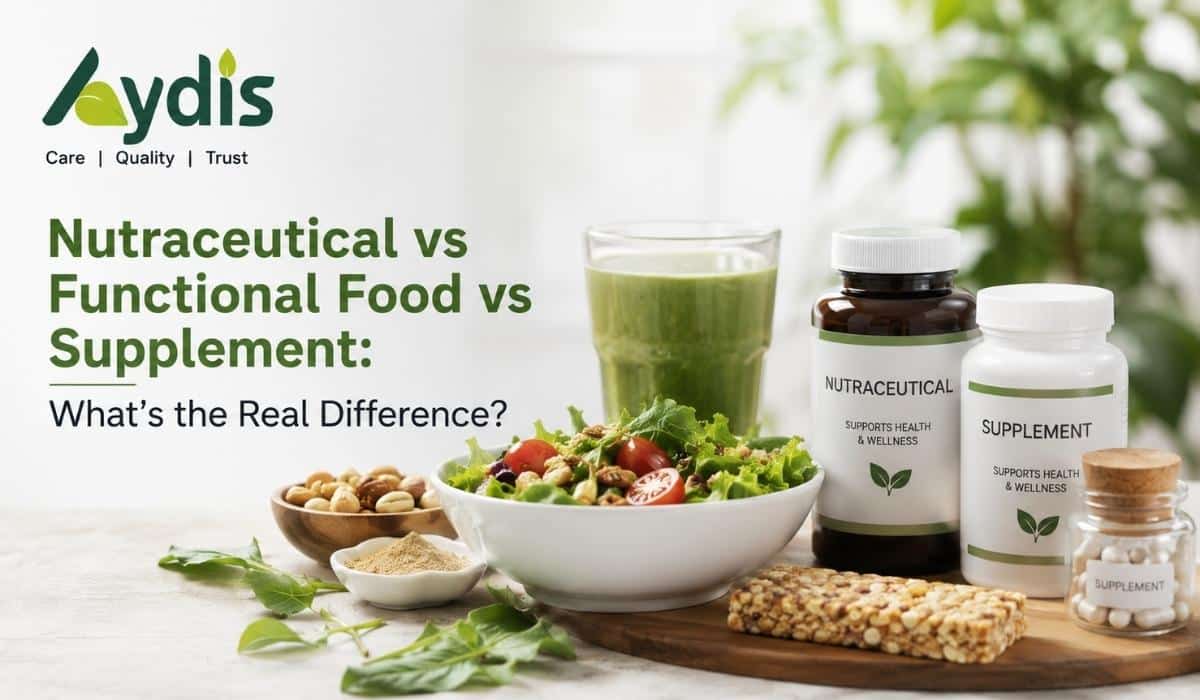
Why These Three Categories Confuse Brands and Buyers
Walk into any pharmacy, health store, or browse any wellness brand’s website, and you’ll likely see all three terms — nutraceutical, functional food, and dietary supplement — being used almost interchangeably. Sometimes even on the same product label.
This confusion isn’t accidental. The wellness industry is one of the fastest-growing sectors in India and globally, and the lines between these three categories are genuinely blurry — by science, by regulation, and by the way brands choose to position their products.
For buyers, the confusion leads to poor purchasing decisions. For brand owners and manufacturers, it leads to something far more costly: launching a product under the wrong regulatory category, making claims you’re not permitted to make, or targeting the wrong audience entirely.
The difference between nutraceutical and functional food, or between nutraceuticals and dietary supplements, isn’t just academic. It shapes your formulation, your packaging claims, your FSSAI licensing pathway, and ultimately how your product is perceived by the end consumer.
This guide settles the confusion — once and for all.
What Is a Nutraceutical? Definition + Examples
The word “nutraceutical” was coined by blending “nutrition” and “pharmaceutical” — and that combination tells you almost everything you need to know.
A nutraceutical is a bioactive compound derived from a food source, concentrated and delivered in a pharmaceutical-style format — capsule, tablet, liquid, or powder — at doses high enough to produce a measurable, targeted health benefit that you cannot realistically get from eating regular food alone.
The key features that define a nutraceutical are:
- It is derived from a natural food source (not synthetically manufactured from scratch)
- It is delivered in a non-food format — you take it like a medicine, not eat it like a meal
- It provides a specific, targeted health benefit beyond general nutrition
In India, the FSSAI regulates nutraceuticals under its Food Safety and Standards (Health Supplements, Nutraceuticals, Food for Special Dietary Use, Food for Special Medical Purpose, Functional Foods and Novel Foods) Regulations 2022. Under these rules, nutraceutical products must not claim to treat, cure, or prevent disease — they can only make general wellness or functional claims.
Examples of nutraceuticals:
- Omega-3 fatty acid capsules (concentrated from fish or algae oil)
- Curcumin extract softgels (concentrated from turmeric root)
- Probiotic capsules (isolated and concentrated live microbial strains)
- Ashwagandha root extract capsules
- Lycopene supplements (extracted from tomatoes in concentrated form)
- Coenzyme Q10 (CoQ10) capsules
Notice a pattern? In each of these cases, the beneficial compound already exists in a natural food — but to get a therapeutic dose of curcumin, you’d need to consume kilograms of turmeric every day. The nutraceutical format solves that problem.
What Is a Functional Food? Definition + Examples
A functional food is, at its simplest, food that does more than just provide calories and basic nutrients. It looks like food, it is eaten like food, and it fits into your daily diet as food — but it has been naturally selected or intentionally enhanced to provide an additional health benefit above and beyond what a standard version of that food would offer.
The critical distinction: you consume functional foods as part of a meal. You take nutraceuticals as a supplement to a meal.
Functional foods can be naturally occurring or fortified. A naturally functional food is one where the health benefit comes from compounds the food already contains — for example, oats naturally contain beta-glucan, a soluble fibre that supports healthy cholesterol levels. A fortified functional food is one where a bioactive ingredient has been added during processing — for example, iodized salt (regular salt with iodine added), or milk fortified with Vitamin D.
In India, functional foods fall under the same FSSAI regulatory framework as nutraceuticals, though the compliance pathway differs based on whether the product is fortified and how health claims are framed on the label.
Examples of functional foods:
- Oats (naturally high in beta-glucan for heart and cholesterol support)
- Fortified milk (with added Vitamin D and calcium beyond standard levels)
- Probiotic yoghurt (with live cultures added for digestive health)
- Iodized salt (standard table salt fortified with iodine)
- Turmeric milk or golden milk blends (whole food format with curcumin intact)
- Green tea (naturally contains catechins and L-theanine)
- Fortified breakfast cereals (vitamins and minerals added during processing)
Functional foods are increasingly popular in India’s direct-to-consumer market because they feel more accessible than supplements — people trust eating food over taking pills, and brands can leverage this perception in their positioning.
What Is a Dietary Supplement? Definition + Examples
A dietary supplement is a product specifically designed to supplement a person’s daily nutritional intake. It fills a nutritional gap — something your diet isn’t providing in adequate amounts — and can contain vitamins, minerals, herbs, amino acids, enzymes, or other dietary substances. Like nutraceuticals, dietary supplements are consumed in non-food formats: tablets, capsules, liquids, softgels, powders, or sachets.
If this sounds similar to nutraceuticals, that’s because there is genuine overlap — and the terms are sometimes used interchangeably, particularly in the Indian and US markets. The meaningful distinction comes down to intent and specificity.
A dietary supplement is primarily concerned with correcting a deficiency or maintaining general nutritional adequacy. A nutraceutical is concerned with delivering a bioactive compound at a therapeutic dose to achieve a specific functional outcome — it often goes beyond filling a gap to actively targeting a health goal.
Another way to think about it: all nutraceuticals are dietary supplements, but not all dietary supplements are nutraceuticals. A standard multivitamin fills nutritional gaps — it’s a supplement. A high-potency ashwagandha extract formulated to support cortisol regulation is targeting a specific outcome — that’s a nutraceutical.
Examples of dietary supplements:
- Standard multivitamin and multimineral tablets
- Vitamin C tablets (basic immune support and deficiency correction)
- Iron supplements (for anaemia management or dietary gap filling)
- Calcium + Vitamin D tablets (for bone density maintenance)
- Protein powders and amino acid blends (for muscle nutrition)
- Zinc supplements (for immune and skin health)
- B-complex tablets (for energy metabolism and nervous system support)
Full Comparison Table: All Three Categories
| Factor | Nutraceutical | Functional Food | Dietary Supplement |
|---|---|---|---|
| Form | Capsule, tablet, liquid, powder (pharmaceutical format) | Looks and functions like food | Tablet, capsule, powder, liquid, sachet |
| How Consumed | Taken separately, like a medicine | Eaten as part of a regular meal | Taken separately, like a medicine |
| Primary Purpose | Targeted health benefit at concentrated doses | Health benefit beyond basic nutrition | Fill nutritional gaps; general health maintenance |
| Source | Derived from whole food or food compounds | Natural food, often fortified | Vitamins, minerals, botanicals, amino acids |
| Bioactive Concentration | High — exceeds what food consumption can provide | Moderate — present in food form | Varies — from basic RDA levels to higher doses |
| Indian Regulation | FSSAI Nutraceuticals Regulations 2022 | FSSAI Functional Foods Regulations 2022 | FSSAI Health Supplements Regulations 2022 |
| Health Claims Permitted | Functional claims; no disease cure claims | Functional and nutrition claims | Structure/function claims; no disease cure claims |
| Common Examples | Omega-3 capsules, curcumin extract, probiotics | Probiotic yoghurt, fortified milk, oats | Multivitamins, iron tablets, protein powder |
The most important regulatory takeaway for Indian brand owners: none of these three categories permit disease treatment or prevention claims on their labels or marketing. Claims like “cures diabetes” or “prevents cancer” will immediately attract FSSAI scrutiny regardless of which category your product falls in.
Which Category Is Right for Your Brand?
Choosing the right category is a strategic decision that affects your formulation, your regulatory pathway, your manufacturing process, your packaging design, and the health claims you’re legally permitted to make. Here’s a practical framework to help you decide.
Choose the nutraceutical route if: You want to offer a product targeting a specific health concern — immunity, joint support, gut health, cognitive function, hormonal balance — at a dose meaningful enough to produce a measurable outcome. Your customer is health-conscious, willing to take a capsule daily, and expects a result. This is the highest-growth category in India right now, and the one where private label and third-party manufacturing deliver the best speed-to-market.
Choose the functional food route if: You already operate in the food and beverage space, or you’re targeting a consumer who resists “taking supplements.” Probiotic drinks, fortified snacks, enriched dairy products, and health teas are all functional food opportunities. The regulatory path involves food licensing rather than supplement licensing, and manufacturing requirements differ accordingly.
Choose the dietary supplement route if: Your product is straightforward — a multivitamin, a basic mineral supplement, a protein powder. The compliance pathway is well-established, consumer awareness is high, and the category is competitive but familiar. This is often the right starting point for first-time supplement brands before expanding into more complex formulations.
A word of caution for brand owners: the category you register under should match the actual claims you make across all touchpoints — your label, your website, your social media, your influencer briefs. Mismatch between registered category and marketing claims is one of the most common and costly regulatory mistakes in this industry.
If you’re still unsure which category your product idea falls into, a formulation conversation with an experienced nutraceutical manufacturer is often the fastest way to get clarity — before you invest in design, packaging, or inventory.
Manufacturing Any of These Categories? Aydis Does It All, Pan-India.
Whether your product is a nutraceutical, a functional food ingredient, or a dietary supplement, getting the formulation and manufacturing right is what determines whether your brand builds lasting trust or faces quality complaints and returns.
Aydis is a GMP and ISO certified nutraceutical and Ayurvedic manufacturer serving brands across India — from startup founders and doctors building their own supplement lines to established e-commerce brands scaling their product portfolio. We manufacture and deliver pan-India.
Here’s what we offer, regardless of which category your product falls in:
- Custom Formulation — from concept to a fully developed, manufacturable formula tailored to your health target and dosage form
- Private Label Manufacturing — launch quickly using proven, market-ready formulations under your brand
- Third-Party Contract Manufacturing — bring your own formula; we manufacture, test, package, and deliver
- Full Dosage Form Range — capsules, tablets, syrups and suspensions, Ayurvedic and wellness oils, powders, and sachets
- Category Expertise — general nutrition, sports nutrition, men’s and women’s health, pediatric nutrition, beauty nutrition, medical nutrition, and veterinary nutrition
- End-to-End Quality Control — aligned with GMP, ISO, and FSSAI standards, with testing built into every production run
- Pan-India Delivery — whether you’re based in Mumbai, Delhi, Bangalore, Hyderabad, or anywhere in between, we ship to you
Starting a new supplement brand or expanding an existing line? We’d be glad to walk you through which category fits your product idea, what formulation options exist, and how to get to market efficiently.
Talk to the Aydis team about your nutraceutical manufacturing project →
Frequently Asked Questions
Q: Is a protein powder a nutraceutical or a dietary supplement?
A protein powder sits primarily in the dietary supplement category when it’s designed to supplement daily protein intake. However, if it’s formulated with specific bioactive ingredients — certain amino acid complexes, adaptogens, or targeted recovery compounds — at clinically relevant doses, elements of it can cross into nutraceutical territory. The category ultimately depends on the formulation, the dose, and the health claims made.
Q: Can a product be both a functional food and a nutraceutical?
In everyday usage, yes — the categories overlap. Technically, the distinction comes down to form: functional foods are consumed as food, while nutraceuticals are consumed in pharmaceutical formats like capsules or tablets. A probiotic yoghurt is a functional food; the same probiotic strain in a capsule is a nutraceutical.
Q: What does FSSAI say about nutraceuticals vs health supplements in India?
The FSSAI’s 2022 regulations define nutraceuticals separately from health supplements, with different labeling and claim requirements for each. Nutraceuticals must contain ingredients that go beyond basic nutrition and provide a functional benefit. Health supplements are primarily about correcting nutritional deficiencies. Both categories prohibit disease treatment or prevention claims.
Q: Do nutraceuticals require a different license than dietary supplements in India?
Under FSSAI’s framework, nutraceuticals, health supplements, and functional foods all require an FSSAI license, but the category under which you register your product determines what claims you can make on the label and how the product is classified during inspections. Your manufacturer should be able to guide you through the right registration pathway for your specific product.
Q: Which category is most popular for private label supplement brands in India?
Nutraceuticals — particularly in formats like capsules, tablets, and powders — are the most common entry point for private label brands. The combination of growing consumer awareness, established manufacturing infrastructure, and the ability to target specific health concerns makes nutraceuticals the most commercially active category in India’s supplement market right now.
Q: How do I know which category my product idea belongs to before I approach a manufacturer?
Start with two questions:
(1) What health claim do I want to make — general nutrition support, or a specific functional outcome?
(2) Is my product consumed as food, or taken as a supplement?
Your answers to these two questions will generally point you in the right direction. A good manufacturing partner can then confirm the correct classification and guide you through the regulatory pathway before you invest in formulation or packaging.
This guide reflects general industry understanding and Indian regulatory context as of 2026. Regulatory requirements evolve — always confirm current FSSAI categorization and labeling rules with a qualified regulatory advisor or your manufacturing partner before finalising product registration and packaging claims.